

Key Takeaways
- The #1 result in Google has an average of 3.8x more backlinks than positions 2–10, making a data-driven link building strategy essential for competitive rankings in 2026.
- Only 2.2% of content published online earns more than one referring domain within a year — original research, proprietary data, and interactive tools are the most reliable linkable assets.
- Google's 2026 algorithms prioritize topical relevance and E-E-A-T signals over raw domain authority, meaning a niche-relevant DR 40 link can outperform a generic DR 80 link.
- Digital PR campaigns generate an average of 10–24 high-authority backlinks per campaign, making them one of the most cost-effective link building methods at scale.
- Use "The Link Value Pyramid" framework to categorize and prioritize link opportunities across four tiers: editorial, resource, partnership, and community links.
- Sustainable link building requires anchor text diversity, natural link velocity, and regular backlink audits to avoid algorithmic penalties and manual actions.
Introduction: Why Your Link Building Strategy Needs a Data-Driven Overhaul in 2026
Link building remains one of the most powerful ranking factors in 2026, but the tactics that work have fundamentally changed. The days of mass outreach templates, reciprocal link exchanges, and private blog networks (PBNs) aren't just over — they actively trigger Google penalties that can devastate your organic visibility overnight.
Consider this: 66.31% of pages have zero backlinks pointing to them, and those pages correlate strongly with receiving no organic search traffic whatsoever, according to Ahrefs' Content Explorer data analysis. Meanwhile, the pages that do earn links — and earn them the right way — compound their authority over time, creating an increasingly insurmountable competitive moat.
Data-driven decision-making is now the cornerstone of every successful modern link building strategy. Rather than guessing which sites to target or which content to create, today's top SEOs use quantitative insights at every stage — from competitor analysis and prospecting to outreach optimization and ROI measurement.
This comprehensive guide covers everything you need to build a scalable, penalty-proof link building strategy in 2026: from reverse-engineering competitor backlink profiles to creating linkable assets that stand out in an AI-saturated landscape, to measuring the true return on your link building investment.
What a Modern Link Building Strategy Looks Like in 2026
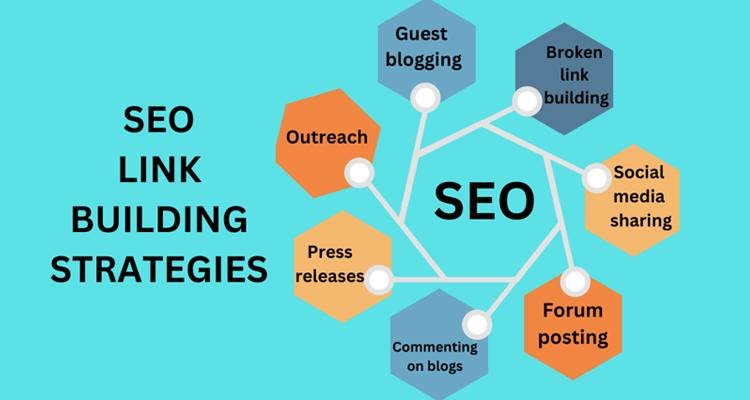 Image Source: ITCombine
A data-driven link building strategy is defined by using quantitative insights to guide every prospecting, outreach, and evaluation decision. It replaces gut instinct with metrics, replaces spray-and-pray outreach with surgical targeting, and replaces vanity metrics with meaningful ROI tracking.
The most significant shift in 2026 is the move from volume-based metrics to quality-based signals. Topical relevance, editorial context, and genuine authority matter exponentially more than raw link counts. A single contextual link from a highly relevant industry publication can move the needle more than fifty links from unrelated, low-quality domains.
"The future of link building isn't about acquiring links — it's about earning trust signals. Every link Google evaluates is now filtered through layers of topical relevance, entity recognition, and contextual authority scoring. If your link building strategy doesn't start with relevance, it doesn't start at all."
— Lily Ray, VP of SEO Strategy & Research, Amsive Digital
Google's 2026 algorithms evaluate backlinks through the lens of E-E-A-T signals — Experience, Expertise, Authoritativeness, and Trustworthiness. This means the linking domain's own authority, the topical clustering of its content, and the contextual placement of the link all factor into how much ranking value that link passes.
Outdated tactics like reciprocal link exchanges, comment spam, and directory submissions no longer move the needle. In fact, Google's link spam policies explicitly target manipulative link schemes, and the SpamBrain AI system has become remarkably effective at identifying and neutralizing artificial link patterns.
What we're witnessing in 2026 is the convergence of link building with content marketing, digital PR, and brand building. The most effective link building strategy is no longer a siloed tactic — it's an integrated approach where every piece of content is designed with link-earning potential in mind, every PR effort generates measurable SEO value, and every brand mention becomes an opportunity for link acquisition.
How to Use SEO Tools to Identify High-Value Link Opportunities
The foundation of any effective link building strategy is data-informed prospecting. Rather than blindly reaching out to websites, you need to systematically identify the highest-value opportunities where your outreach is most likely to succeed.
Leveraging Ahrefs Site Explorer for competitor backlink analysis is the most efficient starting point. Here's the step-by-step process for reverse-engineering competitor link profiles:
- Identify your top 3–5 organic competitors by entering your primary keywords into Ahrefs' SERP overview.
- Analyze each competitor's backlink profile in Site Explorer, sorting by referring domains to understand the breadth of their link portfolio.
- Filter for high-quality links using DR thresholds (typically DR 30+), "dofollow" link type, and organic traffic filters on linking pages.
- Identify replicable link sources — resource pages, editorial mentions, guest contributions, and industry roundups that you could also target.
- Export and categorize opportunities by link type, estimated difficulty, and potential value.
The Content Gap tool is equally powerful for finding topics where competitors earn links but you don't yet have coverage. By inputting multiple competitors and your own domain, you can identify content opportunities that have proven link-earning potential in your niche.
Understanding DR vs. DA: Which Metric Matters More?
| Metric | Domain Rating (DR) — Ahrefs | Domain Authority (DA) — Moz |
|---|---|---|
| Scale | 0–100 (logarithmic) | 0–100 (logarithmic) |
| What It Measures | Strength of a domain's backlink profile based on quantity and quality of referring domains | Predicted ranking ability based on Moz's link index and machine learning model |
| Data Source | Ahrefs' proprietary web crawler and link index | Moz's proprietary link index (Link Explorer) |
| Update Frequency | Continuously updated | Monthly updates |
| Best Use Case | Evaluating backlink profile strength and prospecting link targets | General authority benchmarking |
| Google Metric? | No — third-party proxy only | No — third-party proxy only |
Neither metric is a Google ranking factor, but both serve as useful directional proxies. For link building strategy purposes, DR combined with organic traffic data provides the most reliable picture of a prospect's actual value, since it confirms that Google trusts the domain enough to send it traffic.
When building your prioritized prospect list, apply these minimum filters: DR 30+, at least 500 monthly organic visitors, topical relevance to your niche, and a spam score below 5%. Tools like Semrush, Majestic, and Google Search Console backlink reports can complement your Ahrefs data for a more comprehensive view.
Quality Over Quantity: How Google Evaluates Backlinks in 2026
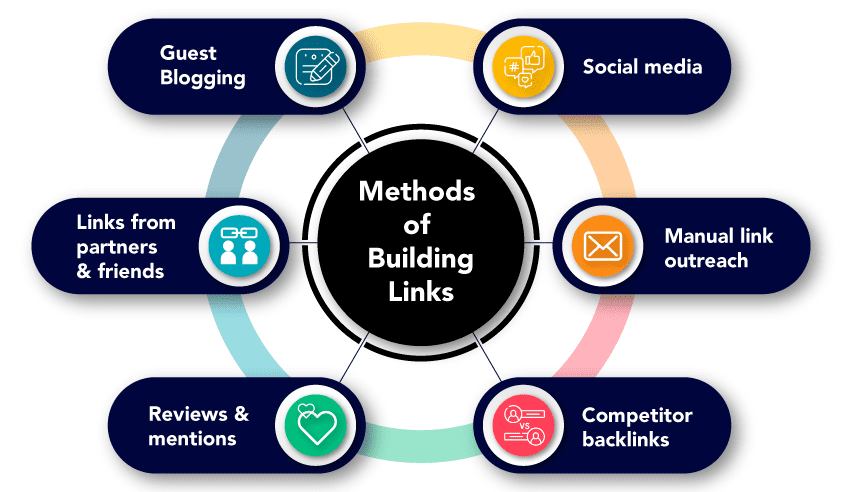 Image Source: The Munro Agency
Understanding how Google evaluates links is critical to building a link building strategy that delivers lasting results. The foundational concept of links as "votes of confidence" dates back to Stanford University's original PageRank paper by Larry Page and Sergey Brin, but the sophistication of link evaluation has evolved dramatically.
In 2026, topical relevance is the dominant factor in link evaluation. Google's algorithms use entity recognition and semantic analysis to determine whether a linking page's content is topically related to the target page. A link from a niche-relevant site with DR 40 can genuinely outperform a generic DR 80 link from an unrelated domain.
Topical authority clusters work by evaluating the linking domain's overall content focus. If a website consistently publishes authoritative content about digital marketing and links to your SEO guide, that link carries significantly more weight than a link from a general-interest site that happens to have a single article tangentially related to your topic.
The diminishing returns of multiple links from the same domain are well-documented. Your link building strategy should prioritize diversified referring domain growth over accumulating multiple links from the same sources. According to Ahrefs' research, the #1 result in Google has an average of 3.8x more backlinks than positions 2–10, but the diversity of referring domains matters as much as the total count.
Editorial links embedded within valuable, contextual content consistently outperform sidebar links, footer links, and author bio links. Google's algorithms can distinguish between a naturally placed editorial reference and a manufactured link placement, and the ranking value differs substantially.
Proven Link Building Tactics That Work in 2026
Not all link building tactics deliver equal results. To help you prioritize your efforts, I've developed The Link Value Pyramid — a framework that categorizes link opportunities into four tiers based on their authority impact, acquisition difficulty, and expected ROI.

The Link Value Pyramid: A Framework for Prioritizing Link Opportunities
| Tier | Link Type | Examples | Avg. Authority Impact | Acquisition Difficulty | Expected ROI |
|---|---|---|---|---|---|
| Tier 1: Editorial | Earned editorial mentions in high-authority publications | News coverage, data citations, expert quotes | Very High | High | 10–25x cost |
| Tier 2: Resource | Inclusion in curated resource pages, guides, and roundups | Industry resource lists, "best tools" roundups, educational guides | High | Medium | 5–15x cost |
| Tier 3: Partnership | Strategic collaborations with complementary brands and creators | Co-authored research, joint webinars, podcast appearances | Medium-High | Medium | 3–8x cost |
| Tier 4: Community | Organic mentions from community engagement and thought leadership | Forum references, social shares that generate links, community contributions | Medium | Low | 2–5x cost |
The most effective link building strategy in 2026 combines tactics across all four tiers, with the heaviest investment directed toward Tier 1 and Tier 2 activities.
Digital PR and Data-Driven Content Marketing
Digital PR has emerged as the single most efficient link building method at scale. Digital PR campaigns generate an average of 10–24 high-authority backlinks per campaign, according to BuzzStream/Fractl industry survey data. The key is creating original research, surveys, and data studies that journalists and bloggers naturally want to cite.
"The best link building campaigns in 2026 don't feel like link building at all. They feel like journalism. When you produce original data that tells a compelling story, the links follow naturally because you've created something the internet genuinely needs."
— Tim Soulo, CMO & Product Advisor, Ahrefs
Building interactive tools, calculators, and data visualizations as linkable assets is particularly effective. Consider creating a Link Building ROI Calculator that estimates traffic value from projected link acquisition — this type of utility-driven content earns links passively because it provides ongoing value to the community.
Newsjacking and reactive PR also remain powerful: providing expert commentary on trending topics to journalists on tight deadlines can generate high-authority editorial links with minimal content creation overhead.
HARO Alternatives, Broken Link Building, and Resource Page Outreach
The journalist sourcing landscape has evolved significantly beyond the original HARO/Connectively model. In 2026, platforms like Qwoted, SourceBottle, and AI-powered journalist matching tools offer more targeted opportunities to connect with reporters seeking expert sources.
Broken link building remains a viable tactic when executed with data. Using Ahrefs' broken link checker, you can identify pages with strong backlink profiles that have gone offline, then create superior replacement content and reach out to the sites linking to the dead resource. The conversion rates are typically higher than cold outreach because you're solving a real problem for the webmaster.
Resource page outreach — identifying curated resource pages in your niche and earning inclusion with genuinely valuable content — continues to deliver consistent results when the outreach is personalized and the content truly merits inclusion.
A Step-by-Step Framework for Building a Scalable Link Building Strategy
 Image Source: Visme
Scaling a link building strategy requires systematization. Here's a seven-step framework designed for repeatability and measurable results:
Step 1: Audit your current backlink profile. Use Ahrefs to identify strengths, weaknesses, toxic links, and anchor text distribution. This baseline tells you where you stand and what gaps need filling.
Step 2: Conduct competitor backlink analysis. Benchmark your link profile against the top 5 ranking competitors for your primary keywords. Identify the referring domain gap and catalog replicable link sources.
Step 3: Create linkable assets. Invest in original research, comprehensive guides, interactive tools, and data visualizations. Remember: only 2.2% of content published online earns more than one referring domain within a year — your content must be exceptional to break through.
Step 4: Build a targeted prospect list. Apply DR, relevance, and traffic filters in Ahrefs to create a prioritized outreach list of 100–200 prospects per campaign.
Step 5: Craft personalized outreach emails. Templates should prioritize your value proposition over generic link requests. Lead with what the prospect gains — a valuable resource for their audience, a data point for their article, or a solution to a broken link.
Step 6: Implement a relationship management system. Track outreach, follow-ups, and conversions using a CRM or structured spreadsheet. The average successful link building campaign requires 2–3 follow-ups per prospect.
Step 7: Scale through repeatable processes. Systematize prospecting, templatize outreach variations, and train team members on quality standards. Additionally, ensure your internal linking strategy complements your external link building efforts for maximum authority distribution across your site.
Creating Linkable Assets That Stand Out in an AI-Saturated Content Landscape
The proliferation of AI-generated content has created a paradox: there's more content than ever, but less of it is worth linking to. Generic, AI-produced articles have flooded the web, making truly original content more valuable — and more linkable — than at any point in SEO history.
"In a world where anyone can generate 1,000 words on any topic in seconds, the currency of the web has shifted from information to insight. Original data, first-hand experience, and genuine expertise are the new link magnets — because they're the things AI fundamentally cannot fabricate."
— Rand Fishkin, Co-founder, SparkToro
The data supports this: long-form content (3,000+ words) earns 77.2% more referring domains than short-form articles on average, according to a Backlinko/BuzzSumo content study. But length alone isn't the differentiator — it's the depth of original insight, proprietary data, and expert analysis within that content.
The most effective linkable assets in 2026 include:
- Industry benchmarks and annual reports — e.g., "2026 Link Building Benchmarks by Industry" showing the average referring domains needed to rank on page 1
- Interactive tools and calculators — utility-driven content that earns passive links over time
- Original surveys and primary research — data that doesn't exist anywhere else
- Expert roundups with genuine insights — curated perspectives from recognized authorities
- Comprehensive visual content — infographics, charts, and embedded data visualizations that are easy to reference and cite
Balancing AI-assisted content creation with human expertise is the key. Use AI tools for research synthesis and draft generation, but layer in original data, expert interviews, case studies with real results, and first-hand experience to satisfy both Google's E-E-A-T requirements and the discerning standards of potential linkers.

Maintaining a Natural Link Profile: Link Velocity, Anchor Text, and Penalty Avoidance
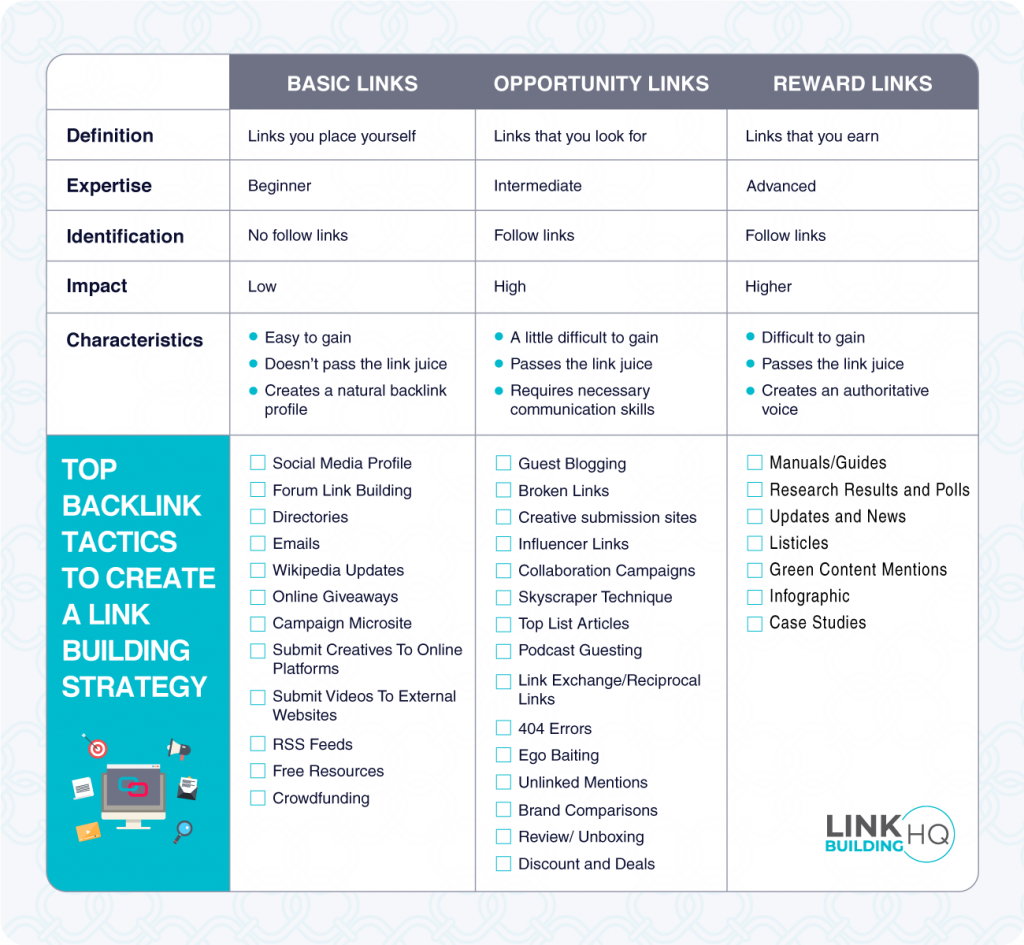 Image Source: Link Building HQ
Link velocity — the rate at which your site acquires new backlinks — is a signal Google monitors for signs of manipulation. Sudden spikes in backlink acquisition, particularly from low-quality sources, can trigger algorithmic scrutiny or even manual actions.
A sustainable link building strategy mirrors organic growth patterns. If your site typically earns 5–10 new referring domains per month, jumping to 200 in a single month raises red flags. Gradual, consistent growth is the safest approach.
Anchor text diversity is equally critical. Here are the recommended ratios for a natural-looking anchor text profile in 2026:
| Anchor Text Type | Recommended Ratio | Example |
|---|---|---|
| Branded anchors | 30–40% | "Ahrefs," "Ahrefs blog" |
| Naked URLs | 20–25% | "https://ahrefs.com" |
| Generic anchors | 15–20% | "click here," "this resource," "learn more" |
| Partial-match keywords | 10–15% | "effective link building tips," "strategies for building links" |
| Exact-match keywords | 3–5% | "link building strategy" |
Use Ahrefs Site Explorer's anchor text report to regularly audit your anchor text distribution. If you notice over-optimization — particularly an unnaturally high percentage of exact-match keyword anchors — take corrective action by diversifying future link acquisition and, if necessary, disavowing toxic backlinks through Google Search Console.
Common link building mistakes that lead to penalties include: purchasing links from link farms, participating in large-scale link exchange schemes, using automated link building software, and building links exclusively with exact-match anchor text. Recovery from a manual action typically takes 3–6 months and requires a thorough disavow process combined with a reconsideration request.
How to Measure Link Building ROI: Metrics That Matter
Measuring the return on your link building strategy investment requires tracking multiple metrics across different time horizons. Here are the KPIs that matter most:
Referring domain growth is the primary indicator of link building success. Track net new referring domains monthly, segmented by quality tier (using The Link Value Pyramid framework above). A healthy link building campaign should deliver a steady upward trajectory in unique referring domains.
Organic traffic correlation is where link building ROI becomes tangible. Monitor the relationship between backlink acquisition and organic traffic improvements using Ahrefs' organic traffic estimates alongside Google Search Console data. While attribution is never perfect — since link building works alongside other SEO activities — the correlation between referring domain growth and organic traffic increases is well-documented.
2026 Link Building Cost Benchmarks
| Link Building Method | Avg. Cost Per Link | Avg. Links Per Campaign | Avg. Link Quality (DR) | Scalability |
|---|---|---|---|---|
| Digital PR | $150–$400 | 10–24 | DR 50–80+ | High |
| Original Research / Data Studies | $200–$600 | 15–50+ | DR 40–70 | Medium |
| Broken Link Building | $50–$150 | 5–15 | DR 30–60 | Medium |
| Resource Page Outreach | $75–$200 | 5–10 | DR 30–55 | Medium |
| Guest Contributions | $100–$350 | 1–3 per month | DR 40–70 | Low |
| HARO/Journalist Sourcing | $25–$100 | 3–8 per month | DR 50–80+ | Low-Medium |
Calculate your cost-per-link and cost-per-referring-domain to evaluate campaign efficiency. Factor in all costs: content creation, tool subscriptions, outreach time (or team salaries), and any agency fees. Then compare against the estimated traffic value of the ranking improvements your links generate — Ahrefs' "Traffic Value" metric provides a useful dollar estimate for this purpose.
Set realistic monthly KPIs: for most mid-sized businesses, targeting 10–20 new referring domains per month from sites with DR 30+ represents a strong, achievable benchmark. Enterprise sites may target 50–100+, while startups might aim for 5–10 high-quality links monthly.
Ready to Build a Data-Driven Link Building Strategy?
Every successful link building strategy starts with data. Ahrefs gives you the competitive intelligence, backlink analysis, and content research tools you need to identify high-value link opportunities, track your progress, and measure real ROI. From Site Explorer's comprehensive backlink profiles to Content Gap analysis and broken link identification, discover how Ahrefs can help you achieve better results.
Start Your Backlink Analysis with AhrefsConclusion: Building Sustainable Authority Through Data-Driven Link Building
The principles of an effective link building strategy in 2026 are clear: prioritize quality over quantity, let data drive every prospecting and outreach decision, and invest in creating genuinely linkable content that the internet needs.
Link building is no longer a standalone tactic — it's inseparable from content marketing, digital PR, and brand authority building. The organizations that win in organic search are those that integrate link acquisition into their broader marketing strategy, creating a virtuous cycle where great content earns links, links improve rankings, rankings drive traffic, and traffic generates the brand recognition that earns even more links.
The long-term compounding effect of a consistent, ethical link building strategy cannot be overstated. Unlike paid advertising, which stops delivering the moment you stop paying, the authority you build through quality backlinks compounds over time. Each new high-quality referring domain makes it easier to rank for more competitive keywords, which in turn attracts more organic links.
Your actionable next step: Run a competitor backlink analysis this week using Ahrefs Site Explorer. Identify your top 10 replicable link opportunities, create one exceptional linkable asset, and begin targeted outreach. The best time to start building a data-driven link building strategy was yesterday. The second best time is right now.
Frequently Asked Questions
What is the most effective link building strategy in 2026?
Data-driven approaches combining digital PR, original research, and targeted outreach based on competitor analysis outperform all other methods in 2026. Digital PR campaigns generate an average of 10–24 high-authority backlinks per campaign, making them the most efficient tactic at scale. The key is creating genuinely valuable content — original data studies, interactive tools, and comprehensive guides — that journalists, bloggers, and industry professionals naturally want to cite and link to. Pair this with systematic competitor backlink analysis using tools like Ahrefs to identify proven link sources in your niche.
How many backlinks do I need to rank on Google?
There is no fixed number of backlinks required to rank, as it depends entirely on your niche, keyword competition, and the quality of links you acquire. However, Ahrefs' research shows that the #1 result in Google has an average of 3.8x more backlinks than positions 2–10. Rather than targeting an arbitrary count, focus on earning high-quality, topically relevant links from authoritative domains. Use Ahrefs' SERP analysis to benchmark the referring domain counts of current top-ranking pages for your target keywords — this gives you a realistic, data-driven target specific to your competitive landscape.
Is link building still important for SEO in 2026?
Yes, backlinks remain a top-three ranking factor in 2026. While Google has added many other signals to its algorithms — including content quality, user experience, and E-E-A-T signals — links continue to serve as fundamental trust and authority indicators. The difference is that Google now evaluates link quality, relevance, and context far more sophisticatedly than ever before. A modern link building strategy focused on earning editorial links from topically relevant, authoritative sites remains one of the highest-ROI SEO activities available.
What is the difference between Domain Rating and Domain Authority?
Domain Rating (DR) is Ahrefs' proprietary metric that measures the strength of a website's backlink profile on a logarithmic scale from 0 to 100, based on the quantity and quality of its referring domains. Domain Authority (DA) is Moz's similar but distinct metric that predicts a site's ranking ability using Moz's own link index and machine learning model. Both are third-party proxy metrics — neither is used by Google directly. For link building prospecting, DR combined with organic traffic data (available in Ahrefs) typically provides the most actionable picture of a prospect's true authority.
How do I avoid Google penalties from link building?
To avoid penalties, maintain anchor text diversity (keep exact-match keyword anchors below 5% of your total profile), acquire links at a natural velocity that mirrors organic growth patterns, and focus exclusively on earning editorial links from topically relevant sites. Regularly audit your backlink profile using Ahrefs to identify and disavow toxic or spammy links. Avoid purchasing links, participating in link exchange schemes, using PBNs, or employing automated link building software. If you follow Google's guidelines and focus on creating content that genuinely earns links, penalty risk is minimal.
Can AI-generated content earn backlinks?
Generic AI-generated content rarely earns backlinks — only 2.2% of all content published online earns more than one referring domain within a year, and undifferentiated AI content performs even worse. However, AI-assisted content that is enriched with original data, expert insights, proprietary research, and unique perspectives can absolutely attract high-quality backlinks. The key distinction is using AI as a productivity tool while layering in the human elements that make content genuinely linkable: first-hand experience, original analysis, expert interviews, and data that doesn't exist anywhere else on the web.